New The SREYUN website is live: five in-house products and reference pricing Learn more →
Ruyi OpsBuddy

Ruyi OpsBuddy AI

Your AI buddy for operations

Describe the task in one sentence and OpsBuddy investigates on its own along a diagnosis loop: detect → hypothesize → gather evidence → conclude → act (with approval) → verify automatically → learn. A single Go binary plus PostgreSQL, the same code for SaaS and self-hosting, and it runs offline even without an LLM.

Ruyi OpsBuddy screenshot

Key features

8 key capabilities of Ruyi OpsBuddy at a glance

01

Seven-stage diagnosis loop

Detect, hypothesize, gather evidence, conclude, act, verify and learn, with evidence at every step; write operations need approval by risk level (L0–L3), are verified automatically afterwards, and nothing is declared fixed without verification

02

Expert skill library

74 skills written to one expert standard (decision trees, root-cause patterns, key metrics and thresholds, real cases), with a CI quality gate of at least 90 points

03

Domain experts and war room

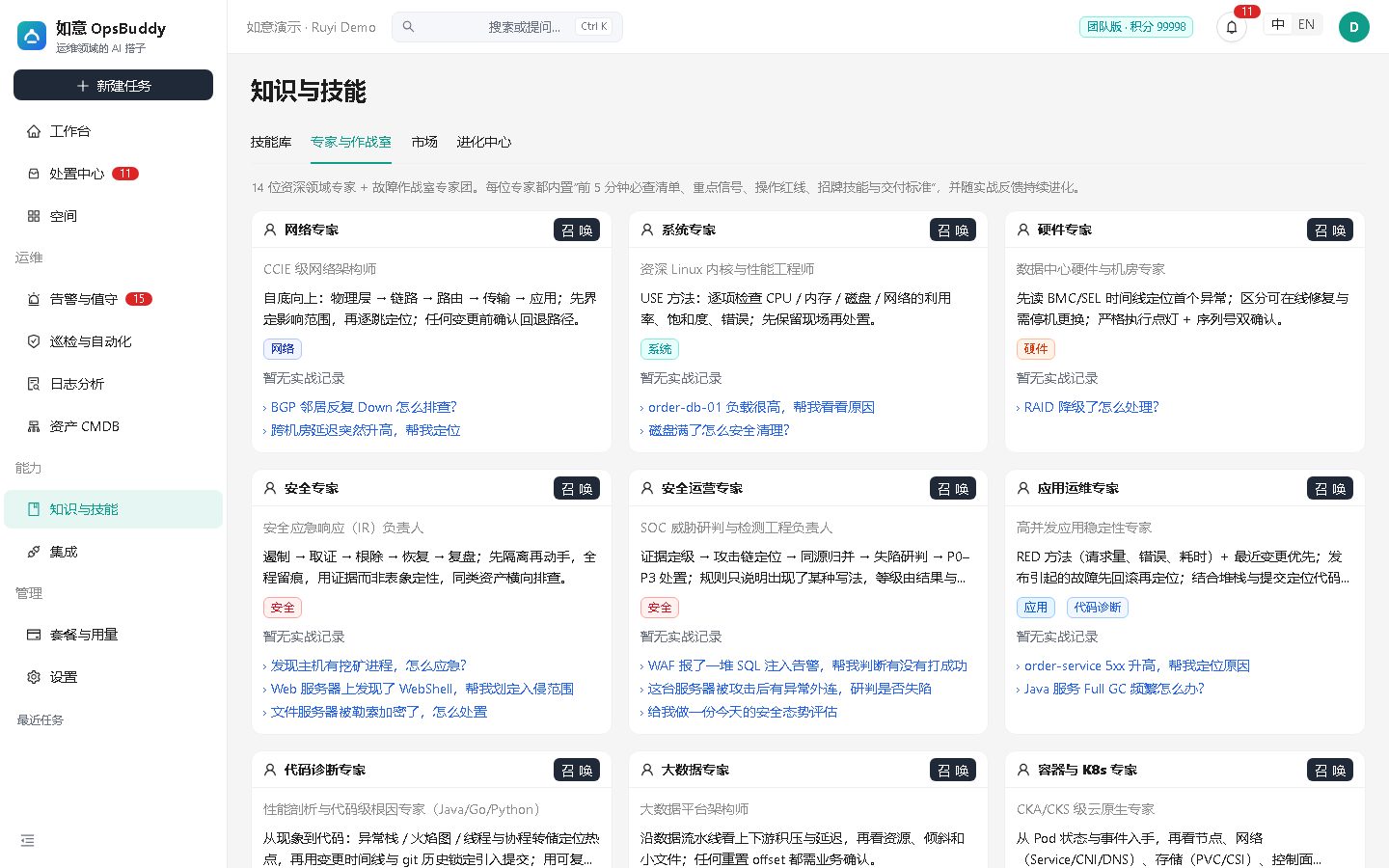
14 domain experts with operating red lines and delivery standards, plus an incident war room team, covering networks, systems, databases, Kubernetes, security, AI infrastructure and more

04

Safe edge execution

The edge executor only makes outbound HTTPS connections and the platform stores no SSH credentials; Ed25519 signatures, local read-only policies, command allow lists, output masking and full audit

05

Multiple models, offline capable

Claude, DeepSeek, Qwen, Ollama, vLLM and others routed by complexity and cost; private models only if you like, and an offline engine when no model is configured

06

Alerts and autonomous on-call

Alertmanager / webhook intake, noise reduction by topology and time window, root cause and propagation chain; self-healing by confidence and risk with verification, complex incidents handed to people

07

Connectors and MCP

17 connector types such as Prometheus, Zabbix, Kubernetes, MySQL and Jira, any MCP / OpenAPI service, and it can act as an MCP server itself

08

Ready to sell

Multi-tenancy, plans, seats, credit metering, online payment, invoices, offline licenses, MSP management and white-labeling

What it is

OpsBuddy investigates rather than just chats. It turns how senior ops engineers troubleshoot into experts and skills, gathers evidence on its own along a seven-stage diagnosis loop and reaches a conclusion; write operations are approved first and verified automatically afterwards, and every investigation becomes reusable team knowledge.

74expert skills (quality gate ≥ 90)
14 + war roomdomain experts
17connector types + any MCP / OpenAPI
0SSH credentials stored by the platform

Screenshots

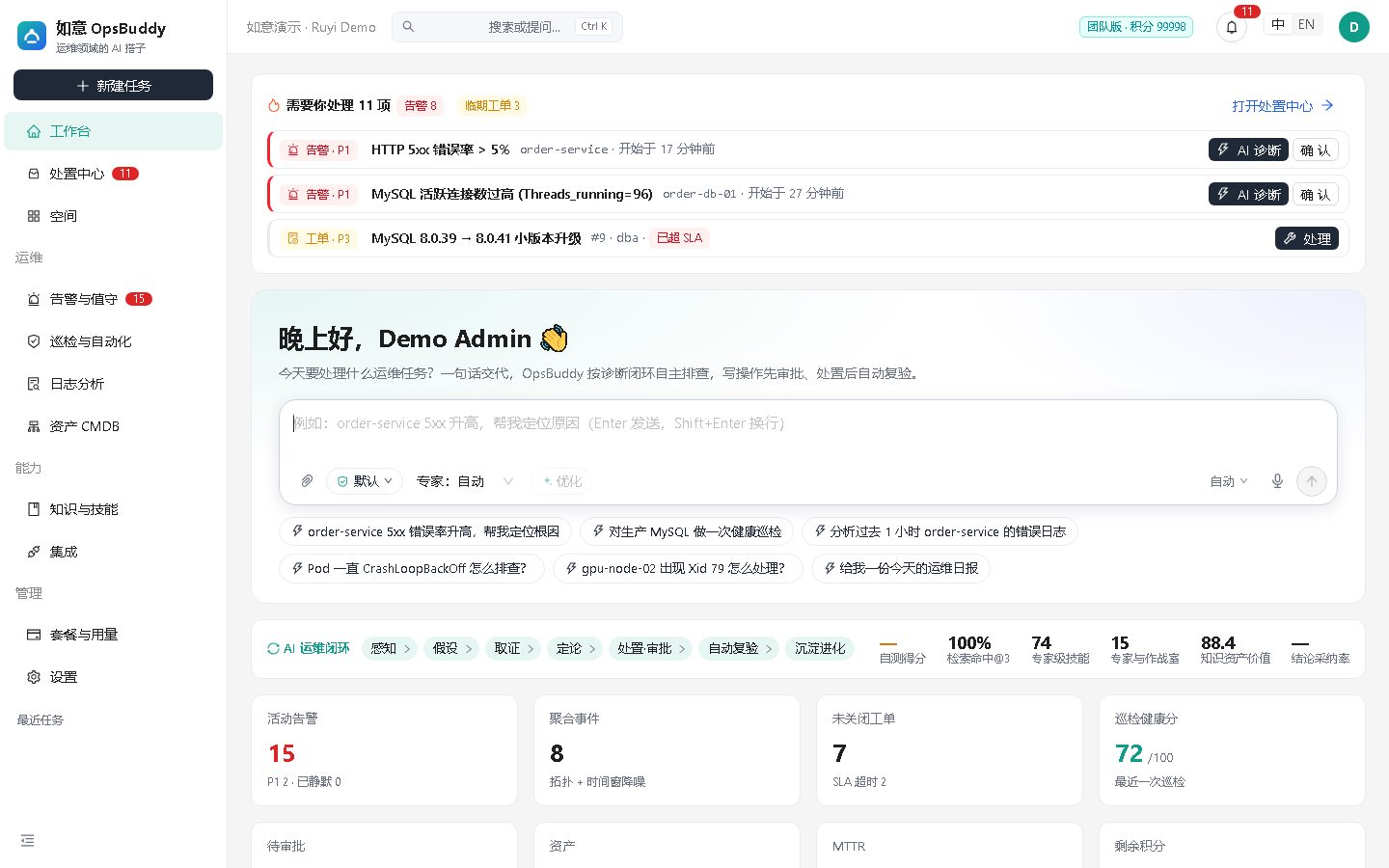
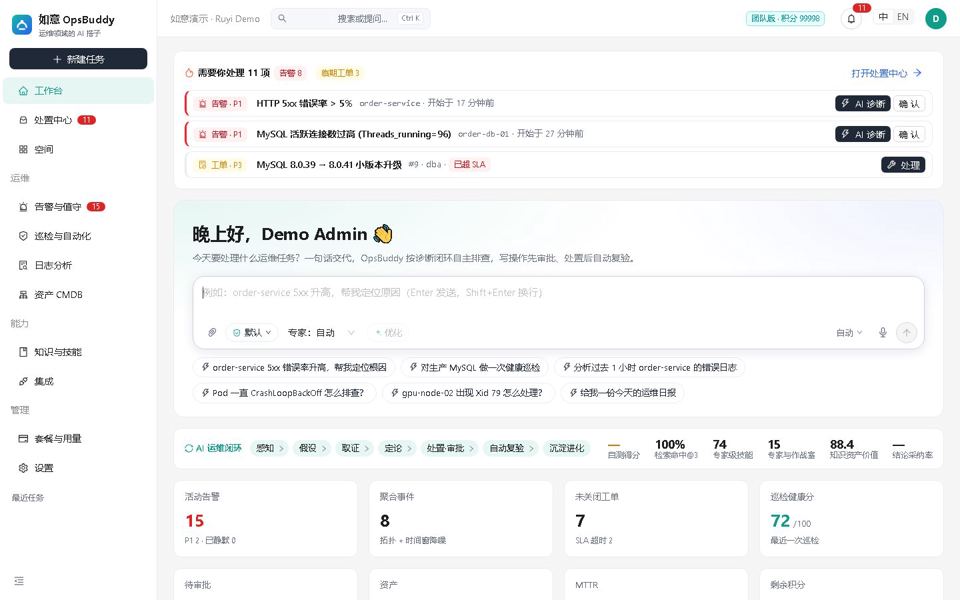
Workbench: pending items, one-sentence tasks and the AI ops loop board
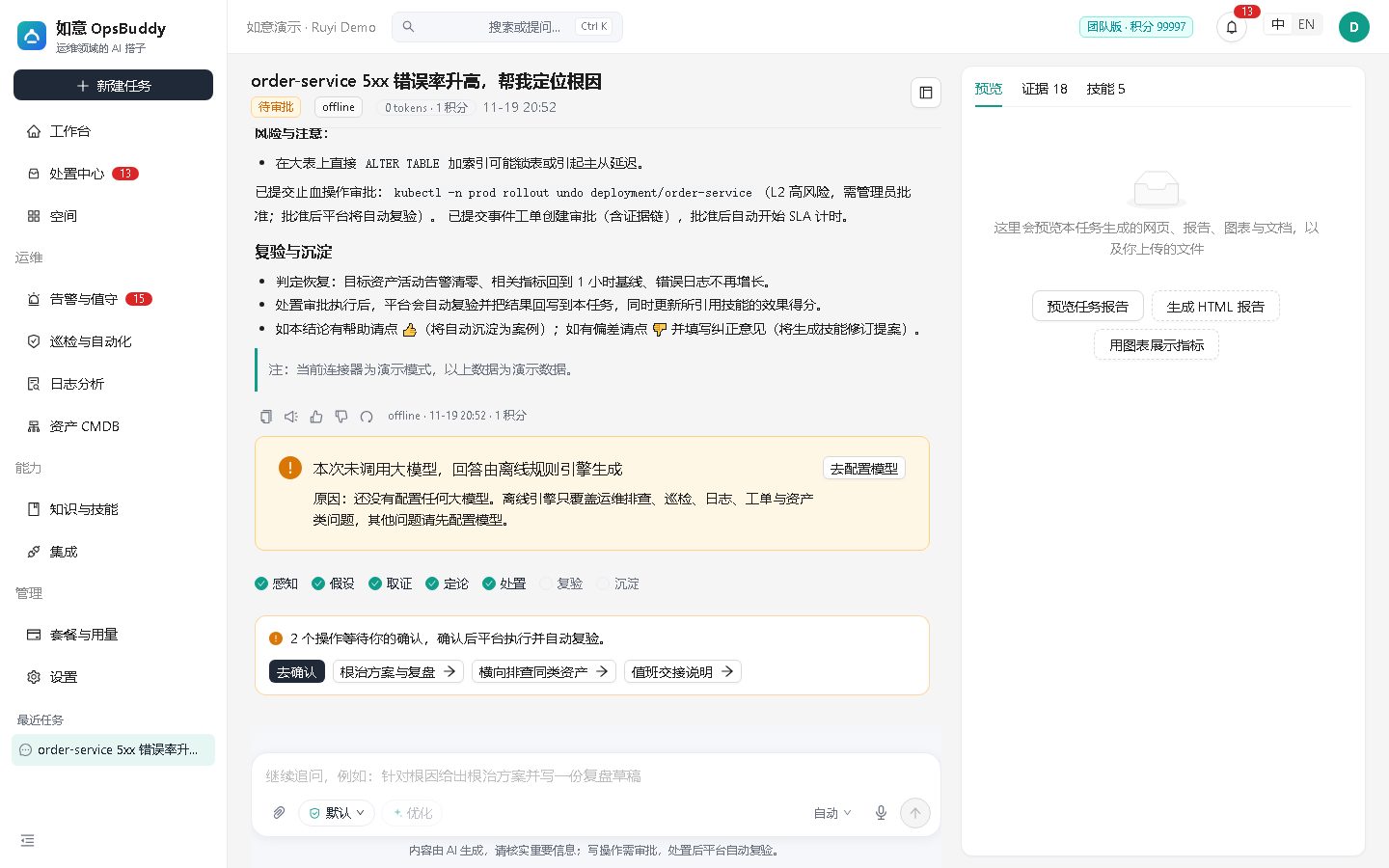
Diagnosis: without an LLM the offline engine reaches a conclusion and proposes operations for approval
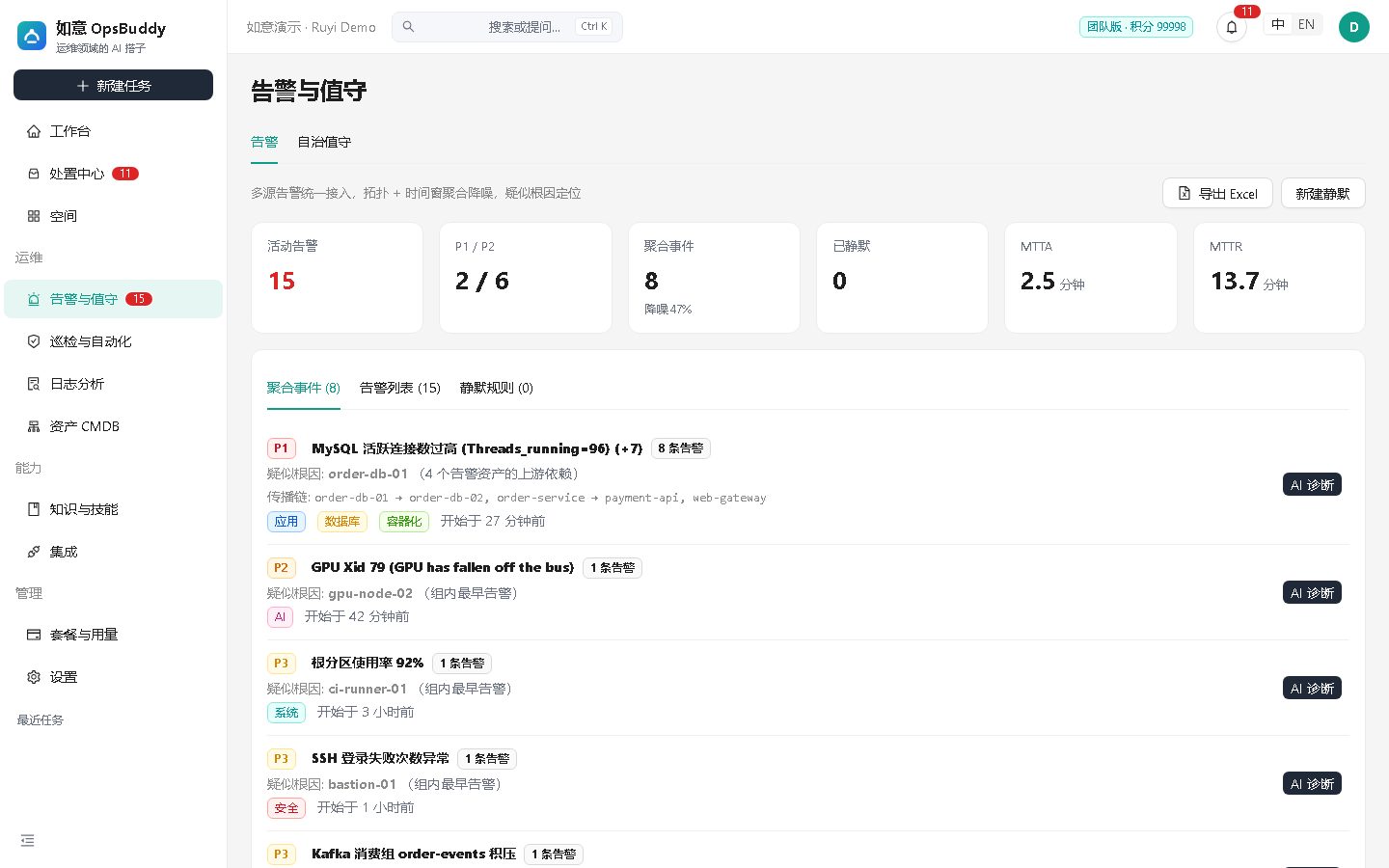
Alerts and on-call: noise reduction by topology and time window, with the likely root cause and propagation chain
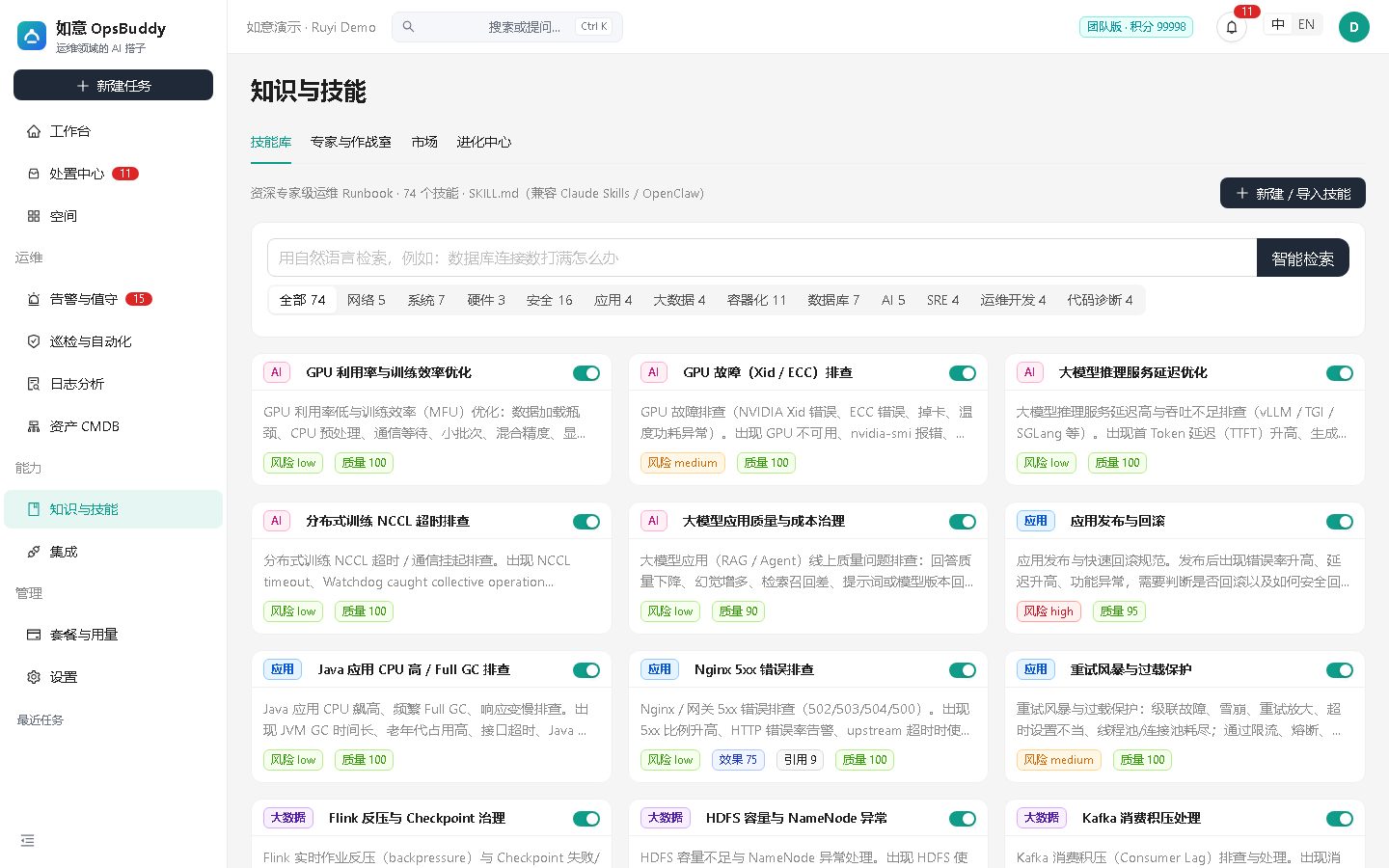
Skill library: 74 expert runbooks with natural-language search
Experts and war room: every expert has a must-check list, operating red lines and delivery standards

The screenshots come from OpsBuddy's built-in demo tenant; all data is demo data.

Use cases

24/7 on-call assistant

Incoming alerts are grouped and analyzed by OpsBuddy first, with an evidence-backed conclusion and recommendation; on-call engineers only confirm and approve

Faster troubleshooting

Describe the task in one sentence and connectors gather the evidence; conclusions can become tickets or group messages in one click, with a diagnosis report that opens offline

Private networks and customer sites

The edge executor only connects outward, so no inbound ports; the platform stores no SSH credentials, and changes need local authorization and approval

Managed service providers (MSP)

An MSP console, customer authorization with permission limits, audit on both sides, and white-labeling of product name, logo, theme color and domain

Security by design

  • Write operations are graded by risk (L0–L3), with multi-level approval chains, separation of duties and on-call schedules.
  • The edge executor has local Ed25519 signatures and read-only policies, so even a compromised platform cannot exceed its rights.
  • Command allow lists, read-only SQL checks, output masking and an HMAC hash chain that makes audit logs tamper-evident.
  • With "private models only" turned on, only local models such as Ollama and vLLM are used.

Deployment

Install with Docker Compose (amd64 and arm64 images) or a Linux systemd package; database migrations run at startup. Connect a customer host to the edge executor with one command:

docker compose pull && docker compose up -d     # open http://SERVER_IP:8080
curl -fsSL https://YOUR_PLATFORM/install/edge.sh | sudo bash -s -- --token obe_xxx --name web-01

SaaS and self-hosting share the same code; when self-hosted, all business data stays in your own PostgreSQL. See pricing for editions and licensing, or book a demo.

Need commercial support or a private deployment of Ruyi OpsBuddy?

We offer demos, deployment, vendor technical support and custom development to get you running faster.